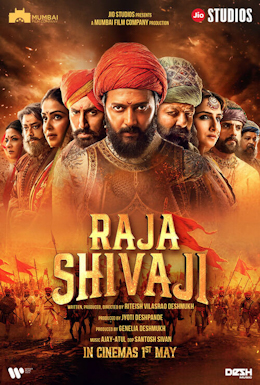

The 2026 historical epic Raja Shivaji is much more than just a film; it is a cinematic landmark that represents a decade of passion, historical research, and a massive financial gamble for Marathi cinema. Directed by and starring Riteish Deshmukh, the film was released on May 1, 2026, to coincide with Maharashtra Day, arriving as the most expensive Marathi production ever made with a budget of ₹100 crore. Produced as a bilingual in both Marathi and Hindi, it seeks to capture the monumental life of Chhatrapati Shivaji Maharaj, the founder of the Maratha Empire.
A Long Road to the Big Screen
The journey of Raja Shivaji began over ten years ago, originally conceptualized around 2015 with Ravi Jadhav set to direct. After several shifts in creative vision including a period where Sairat director Nagraj Manjule was attached to lead a trilogy Riteish Deshmukh ultimately took the directorial reins himself. Deshmukh described the project as a "labour of love and a lifelong dream," spending years immersed in historical texts like Shivcharitra and Shree Raja Shivchatrapati to ensure the screenplay was both respectful and rooted in historical fact.
The Plot: From Shivneri to Raigad
While the film is presented in eight well-structured chapters, it primarily focuses on the early years and the eventual establishment of the Maratha Empire. The narrative arc spans from Shivaji's childhood at Shivneri Fort to the pivotal military and strategic victories that defined his reign. Key historical milestones are depicted with high drama, including his meeting with Rani Saibai, his coronation ceremony at Raigad Fort, and the legendary encounter with Afzal Khan.
One of the film's most intense segments involves the battle sequences choreographed by Dawid Szatarski and Manohar Verma, which highlight Shivaji's unmatched strategic acumen. The story intentionally focuses on the period prior to him becoming "Chhatrapati" in 1674, portraying the grit and vision required to build a sovereign state against the backdrop of Mughal and Adil Shahi influence.
A Powerhouse Ensemble Cast
The film features an ambitious pan-Indian cast that brings together veterans and fresh faces. Riteish Deshmukh delivers a controlled and sincere performance as the titular lead, while his sons, Riaan and Rahyl Deshmukh, make their acting debuts playing the younger versions of the King.
The antagonists provide a heavy-hitting contrast. Sanjay Dutt is widely praised for his "deadly" and menacing portrayal of Afzal Khan, while Fardeen Khan appears as the Mughal emperor Shah Jahan. Abhishek Bachchan takes on the role of Sambhaji Shahaji Bhosale, and Vidya Balan joins the ensemble as Khadija Sultana. The family dynamic is anchored by Bhagyashree as Jijabai and Sachin Khedekar as Shahaji Bhosale.
Perhaps the biggest "mass" moment in the film is the high-impact cameo by Salman Khan, who portrays the loyal warrior Jiva Mahala. Historically known for protecting Shivaji during Sayyad Banda's attack, Khan's appearance was filmed over a two-day schedule and has been a major draw for audiences.
Locations and Visual Grandeur
The production scale is evident in its choice of locations and set design. Filming took place over 100 days across the rugged beauty of the Western Ghats and the Sahyadri mountain ranges. Key schedules were held in Mahabaleshwar, Wai, and Satara, providing an authentic backdrop to the historical narrative.
For the more complex sequences, massive sets were constructed at Film City in Mumbai, including a detailed recreation of Shivneri Fort and parts of other strategic forts. These sets, designed by Nikhil Kovale, Apurva Bhagat, and Shashank Tere, remained in place for over six months and were the result of meticulous study of actual Maratha architecture.
Technical Execution: Highs and Lows
Technically, Raja Shivaji is a film of contrasts. The cinematography marks the Marathi debut of the legendary Santosh Sivan, who uses the natural landscapes of Maharashtra to create a sense of scale. However, some critics felt that the heavy use of slow-motion and CGI occasionally overshadowed the visual storytelling.
The music by Ajay-Atul is arguably the film’s strongest asset. Their score, combined with background music by John Stewart Eduri, provides the emotional and ideological core of the film, helping to elevate the drama even during the film's slower moments.
Despite the ₹100 crore budget, the VFX handled by Assemblage Entertainment has faced mixed reviews. While some sequences are described as "Hollywood-rivalling," others have been criticized as looking "childish" or artificial, particularly in the larger battle scenes.
Reception and Box Office Impact
Upon release, Raja Shivaji immediately began shattering records. It recorded the biggest opening day in Marathi cinema history, collecting ₹11.35 crore net in India, surpassing the previous record held by Sairat.
Critical reception has been a blend of admiration for the film's noble intent and critique of its 195-minute runtime. While some reviewers found it to be a "dignified ode" that delivers a roaring climax, others felt it followed a traditional "good vs. evil" template that stayed on the surface of the history rather than exploring lesser-known anecdotes.
Ultimately, Raja Shivaji stands as a monumental achievement for regional cinema. It is a film that commands respect for its sheer scale and the sincerity of its lead, Riteish Deshmukh, providing a powerful, if flawed, tribute to one of India’s greatest historical icons.